Cloud infrastructure that
holds up at
enterprise scale.
The cloud decisions you make today determine how fast you can ship, how well your systems hold up under load, and how much you pay to run everything. We have been building and migrating enterprise cloud infrastructure since the early days of AWS, Azure, and GCP, and we stay through delivery.
Schedule a Strategy Call
Tell us about your project and we'll get back to you within 24 hours.
Five practices. One team.
No handoffs.
We cover the full cloud lifecycle under one roof. Strategy upfront, engineering in the middle, operations afterward. No gaps between phases, no handoffs to other firms. The same team that built the roadmap executes it.
Decide before you move.
A migration that skips planning costs more than the one that took three months to plan. We map your current state, design the target architecture, and produce a prioritized roadmap before a single workload moves.
No handoff after the plan.
The same team that built the roadmap executes it. Migration, cloud-native engineering, integration, and managed services, all from one practice with shared context on your architecture.
The full stack,
handled in-house.
Each practice connects to the next. Advisory informs the migration. Engineering runs alongside it. Integration handles what stays on-premise. Monitoring picks up when everything is live.
Decide before you move.
Before committing budget to a migration, we map your current state: what runs where, what it costs, what the risk is, and what the right path forward actually looks like. Outputs include a cloud readiness report, reference architecture, TCO analysis, security posture review, and a prioritized migration roadmap.
AWS. Azure. GCP.
We work across all three.
We are not tied to any one provider. We have certified practitioners across all three platforms and recommend based on your workloads, compliance requirements, existing licenses, and total cost of ownership, not on partnerships


Amazon Web Services
Best for workloads requiring the deepest managed-service breadth and the largest partner ecosystem.


Microsoft Azure
Best fit when the enterprise already runs Microsoft: M365, Dynamics, or Active Directory.


Google Cloud Platform
Best fit for analytics-first workloads and organizations building on Kubernetes or Vertex AI.
A migration approach built
around what actually fails.
Most cloud migrations fail because of skipped discovery, missing dependencies, and no success criteria. Our four-phase methodology addresses each of these directly, and we stay through Phase 4 rather than only Phase 1.
Preparation and planning
Define objectives, build the business case, align stakeholders, and establish the governance model. Nothing moves without a clear destination.
Discovery, assessment, and proof of concept
Inventory every asset, map dependencies, assess workload complexity, and validate the architecture with a PoC before committing the full estate.
Design, migrate, and validate
Apply the 5R framework workload by workload. Migrate in waves. Validate against success criteria at each checkpoint before proceeding.
Optimize
Post-migration we tune performance, right-size resources, set up observability, and hand over runbooks. We stay until operations are stable and costs are dialed in.
The right strategy
for every workload.
Large workload portfolios contain applications at every stage of their lifecycle. Some should be rehosted, some refactored, some retired. Applying the wrong strategy to a workload is where migration costs balloon. We assess every workload individually before it moves.
Rehost
Move the workload to cloud infrastructure with minimal code changes. Fast, low-risk, best for stable applications on a deadline.
Replatform
Optimize for cloud during the move: swap the database engine, containerize, or adopt a managed runtime without refactoring app logic.
Refactor
Re-architect for cloud-native benefits: microservices, serverless, event-driven. Higher upfront investment, highest long-term value.
Retain
Some systems should stay. Compliance constraints, latency requirements, or end-of-life timelines may make migration the wrong call entirely.
Retire
If a workload has no active users or a duplicate already exists, retiring it reduces cost and maintenance overhead from day one.
Enterprise cloud work
we have shipped.
A HIPAA-compliant IoT monitoring platform. An industrial sensor network spanning 80 countries. These are production systems built and running at scale.


Bedside monitoring that catches deterioration before it becomes critical
An FDA-cleared, HIPAA-compliant bedside system that detects early clinical deterioration in unmonitored patients. Heart rate, respiratory rate, SpO₂, and temperature captured via body sensor, surfaced to a nursing dashboard with criticality-based alerting, all on a HIPAA-compliant AWS cloud infrastructure.
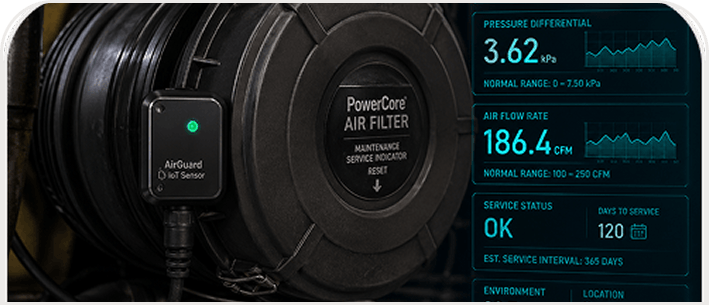

Senzit: IoT fleet management platform deployed across 80+ countries
End-to-end cloud engineering for Mann+Hummel's industrial IoT monitoring platform, covering sensor ingestion through to the fleet management dashboard. Built on AWS IoT Core and running at global scale across 80+ countries, tracking filter performance and maintenance intervals in real time.


Enterprise-wide cloud transformation across 100+ countries
Cloud integration architecture connecting Azure workloads with legacy SAP systems across Syngenta's global operations: incremental by design, no big-bang migration, operational in 100+ countries.
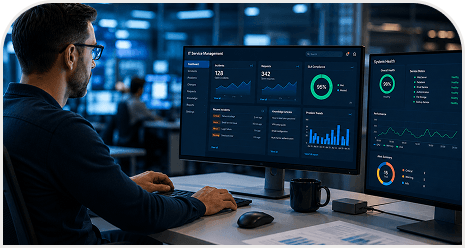
Intelligent IT service management
AIOps-powered IT service management platform on AWS that uses ML-based incident prediction to cut mean time to resolution, reduce L1 ticket volume, and power India's largest network end-to-end.


Omni-channel diagnostics platform at national scale
Rebuilt the patient engagement layer end to end on a hybrid Azure and AWS architecture: consumer app, phlebotomist app with route optimization, ML report-delivery prediction, and 100x throughput scaling from 2K to 30K+ daily orders.
Cloud-native,
built to last.
Our architecture covers every layer of the stack: client, server, and managed cloud services. Every layer is designed to work together so performance, reliability, and cost stay coherent as the system scales.
Server technology
- Apache · NGINX
- Node.js · Python
- Java · PHP
- C# · JBoss
- Linux · Windows Server
Databases
- MySQL · PostgreSQL
- MongoDB · Redis
- Oracle · SQL Server
- DynamoDB · Cosmos DB
Cloud managed services
- API Gateway · App Service
- Queueing & streaming · ML / AI services
- IoT platform · Object storage
- CDN · Serverless compute
Client
- HTML5 / React · Android
- iOS · Xamarin
- React Native · Flutter
- Progressive Web Apps
Infrastructure
What teams ask us
about cloud.
AI-native companies win.
Let's build yours.
Tell us what you are running today and where you need it to go. We come to the first call with questions, not a pitch deck.
Talk to our cloud team →